You Were Paid Yesterday. What Happened?
Why does your salary disappear so quickly? Explore the everyday spending habits, financial pressures, and small expenses that can turn ₦150,000 into a mid-month money crisis.
Loading...

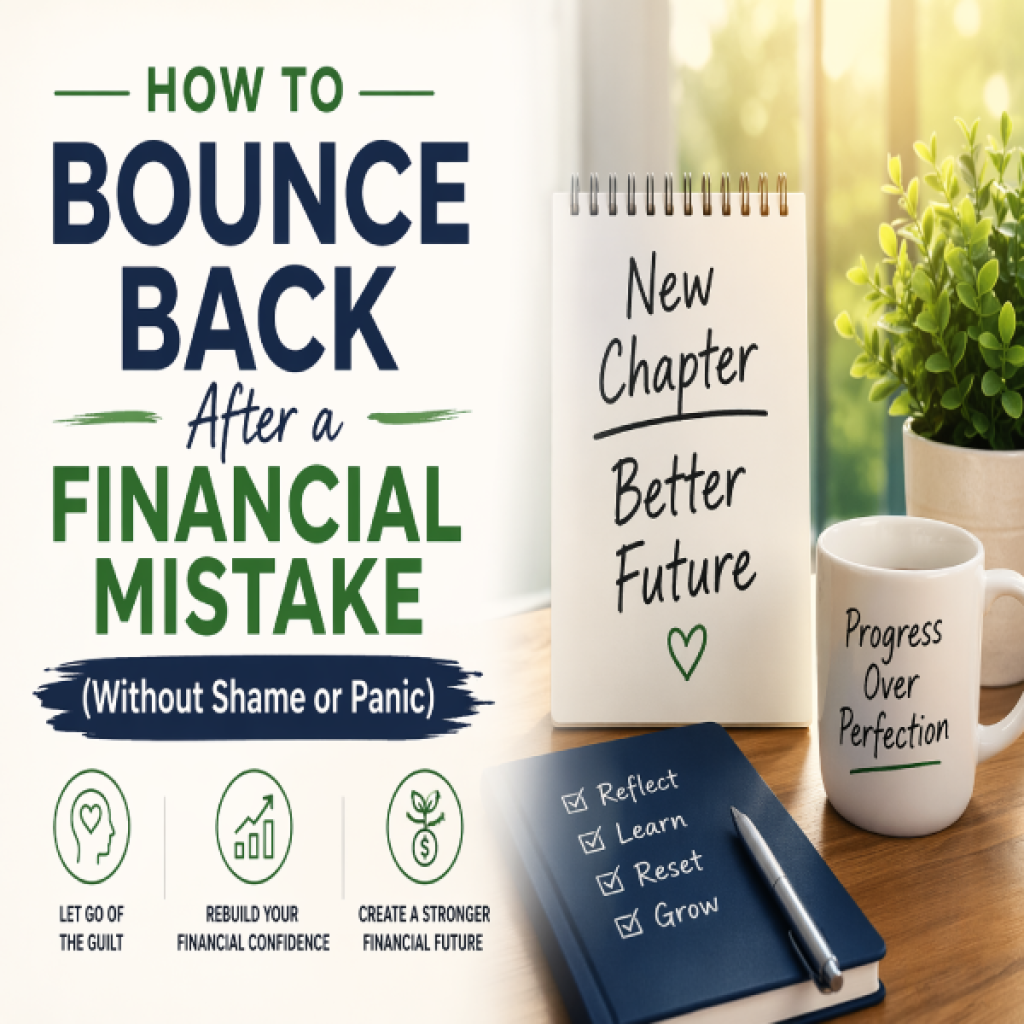
Made a costly financial mistake? Learn how to recover from money loss, stop regret, and rebuild your finances with practical, proven steps.
Table of contents [Show]
There is a very specific, visceral sensation that accompanies a massive money mistake. It is that sudden, icy drop in the pit of the stomach. It usually happens in the quietest part of the night and in that singular moment, the world narrows down to an agonizing truth: the money is gone.
Maybe it was a high-risk investment that was meant to change everything but crashed to zero in a few days. Or worse, money you gave to someone you loved and trusted, knowing deep down you might never see it again.
Whatever the situation was, the outcome is always the same, and the silence after a big financial loss can feel incredibly loud.
Grab a cozy blanket, pour a glass of whatever brings you absolute comfort tonight whether that is rich steaming mug of matcha, or just sparkling water with a ridiculous amount of lemon and let’s settle in. We are going to dive deep into something that almost nobody talks about out loud, even though every single one of us has experienced it.
We need to talk about the financial hangover.
But What is the Shame Spiral?
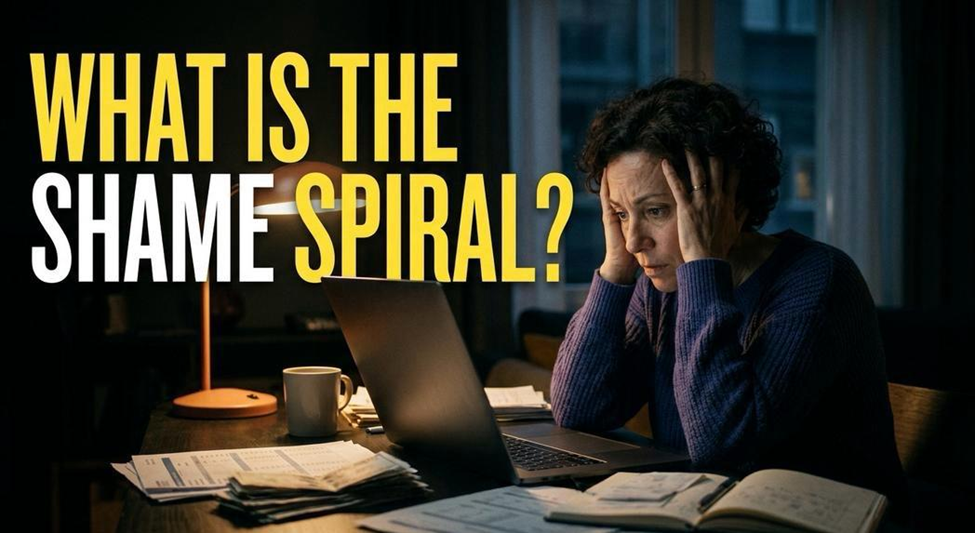
We live in a time where people share almost everything. At dinners, online, anywhere you will hear conversations about breakups, childhood issues, therapy, even personal struggles. People post their daily lives and deepest insecurities for strangers to see.
But when it comes to money, everything changes. Nobody really talks about it. It is still the one thing people keep to themselves.
The shame spiral is that cycle you fall into after making a money mistake. It usually starts with one decision, maybe you overspent, lost money, or trusted the wrong thing. At first, it begins with just regret. But then your thoughts begin to loop. You replay what happened, question your judgment, and start being hard on yourself.
Instead of stopping at “that was a mistake,” it turns into “what is wrong with me?” That shift is where the spiral really begins. The feeling of shame grows, and with it comes avoidance. You might stop checking your account, delay fixing the problem, or pretend it is not there for a while. That particular moment of the decision replays over and over, torturing the mind with the red flags that were ignored.
The tricky part is that the longer you stay in that state, the worse things can get. Avoidance leads to more stress, more pressure, and sometimes even more bad decisions, not because you do not know better, but because you are trying to escape how you feel.
So, it is not just about the money anymore. It becomes a cycle of mistake, shame, avoidance, and deeper consequences that keeps feeding itself.
But carrying that shame does not bring the money back or undo what happened. It only keeps us stuck, trapped in what already went wrong and afraid of what comes next. If we are ever going to move forward, we need to drag this financial shame out of the dark. We have to look at it, dissect it, and understand exactly why it holds so much power over us.
So, how do we actually do it? How do we crawl out of the shame-spiral and get our power back? It happens in five distinct, beautiful, and sometimes uncomfortable steps. Let's walk through them together.

The first phase of finding financial forgiveness is often the most terrifying, because it requires doing the exact opposite of what our survival instincts are screaming at us to do. When a massive financial mistake happens, the natural, human instinct is to hide.
We delete the banking app from our home screens, ignore emails from the brokerage firm, letting them pile up like something we would rather not touch. That expensive, regrettable purchase gets pushed to the back of the closet, buried under old sweaters so it stays out of sight.
Then it becomes easier to pretend the disaster did not happen, hoping that if it is ignored long enough, the anxiety will eventually float away.
But avoidance only feeds the shame and shame thrives in the dark. To begin the healing process, we have to stop running, turn around, and turn on the lights.
This just means logging into the account and looking at the number. Writing it down. Maybe even saying it out loud to yourself. It does not magically fix anything, but at least it is real now and it has a limit.
When you avoid it, your mind starts filling in the blanks and it usually makes things worse than they are. But once you see it clearly, it stops feeling like something huge and unknown. It just becomes something you have to deal with, step by step. And math problems, no matter how large, can eventually be solved.

Once the lights are on and the reality of the situation is clear, we are forced to confront the wreckage. This brings us to the next necessary heartbreak, cutting the anchor.
This phase is about defeating a very dangerous psychological trap known as the sunk cost fallacy. This is the insidious little voice in the back of the mind that convinces us to keep throwing good money after bad, simply because so much has already been invested. It is the urge to keep pouring dwindling savings into a failing side hustle because quitting feels like admitting defeat or the refusal to sell the luxury car that is draining the budget because we don't want to look like a failure to the neighbours.
Stopping the bleeding requires a lot of courage. You have to accept the hard truth that the money you’ve already spent is gone. It’s in the past. Right now, your job is to protect what’s left of your money and your peace of mind.
Cutting the anchor is the exact moment we stop letting the mistakes of the past dictate the trajectory of the future. It is the moment we take our power back.

With the bleeding stopped and the reality accepted, the real emotional heavy lifting begins. You need to untangle your self-worth from your net worth.
You have to remind yourself, over and over again, until you finally believe it, that a bank account is simply a tool. It is a logistical instrument used to navigate a capitalist society and just a means of exchange. It is not a measure of intelligence, morality, kindness, or value as a human being.
Making a bad investment does not mean you are stupid; it means a risk was taken that did not pan out. Buying something completely unaffordable does not mean you are fundamentally broken; it means comfort, status, or joy was sought in a moment of vulnerability, and the marketing department of a billion-dollar corporation did its job perfectly.
Every single person who has ever interacted with money has made a mistake with it. The wealthiest, most successful investors in the world have lost staggering, incomprehensible amounts of money on terrible bets. They have backed the wrong companies, bought at the top of the market, and trusted the wrong people. The difference is not that they don’t fail but how they view failure and those losses as the cost of doing business.
Step Four: Forgive the Past Version of You

This untangling naturally leads to the most profound phase of healing which begins by looking back at the person who made the mistake and offering them a radical forgiveness.
When conducting an autopsy of financial mistakes, it is so easy to be cruel, look back at your past self with disdain and think about how blind you were, how the red flags were everywhere, and how you should have known better. But hindsight is twenty-twenty six, and judging a past decision with present-day knowledge is a rigged game. You are judging the past version of yourself using the wisdom that the mistake itself gave you. It is an unfair trial.
Instead of cruelty, you must look at the version of yourself who made the mistake and realize that they were doing the absolute best they could with the information, the emotional state, and the beliefs they had at that exact moment in time.
Perhaps the bad investment was driven by a desperate, exhausting desire to finally get ahead. Maybe you were tired of living pay-check to pay-check, tired of the anxiety, and a window appeared that looked like an escape route. You wanted to provide a better life for your families or escape a soul-crushing job that was draining your light and that’s completely understandable. The execution may have been flawed, but the intention was rooted in hope.
Forgiveness means giving yourself permission to grieve the loss, and then giving yourself permission to move on. It means accepting that the timeline has shifted and that a delayed timeline is not a destroyed life.
The human capacity for resilience is breath-taking. Think about everything you have already survived in your lives. You have survived heartbreak, illness, profound loss, and deep disappointment. You have rebuilt yourself from the ground up before. You can survive a reset of your financial timeline. The money is gone, but your ability to generate value, to learn, to adapt, and to rebuild remains completely intact. The mistake did not erase your skills, your relationships, your creativity, or your potential.

As the heavy fog of shame finally begins to lift, you are left standing on an empty plot of land. The final phase of this journey is learning how to lay the first new brick.
Rebuilding this trust takes time, and it requires small, gentle actions. There is no need to immediately jump back into the stock market, start a new business, or make massive financial moves. You just need to prove to yourself, in tiny, microscopic increments, that you are capable of managing your resources safely again.
This might look like reading a gentle, approachable book on personal finance to build a stronger foundation of knowledge, replacing fear with education. Or sitting down on a Sunday morning and calmly reviewing the week’s expenses without any judgment or self-criticism, just observing the flow of money. Small positive actions rebuild trust over time. They slowly add up, easing anxiety and replacing it with calm confidence, until you realize the mistake didn’t break you but it simply taught you a lesson.
There is a beautiful Japanese art form called Kintsugi. When a piece of pottery breaks, the artisans do not throw it away, and they do not try to glue it back together seamlessly to hide the damage. Instead, they repair the broken pieces using a special lacquer mixed with powdered gold, silver, or platinum.
In finance, your cracks are your mistakes and when you try to hide those mistakes with more debt or status symbols, you enter a shame spiral. You’re trying to buy a new bowl instead of fixing the one you have.
Stop hiding. Understand that your scars aren't your shame but rather, they’re your proof of competence. Learn to embrace your cracks, fill them with the gold of your lessons, grow from your experience, and watch how much more you earn when you’re finally brave enough to just be you.

Why does your salary disappear so quickly? Explore the everyday spending habits, financial pressures, and small expenses that can turn ₦150,000 into a mid-month money crisis.
Why do we spend money trying to look successful? Explore the psychology behind lifestyle spending, social pressure, and the hidden cost of looking financially fine.
Learn how credit scores work, why they matter, and practical steps you can take to improve your credit score and make borrowing more affordable.