You Were Paid Yesterday. What Happened?
Why does your salary disappear so quickly? Explore the everyday spending habits, financial pressures, and small expenses that can turn ₦150,000 into a mid-month money crisis.
Loading...


In a world filled with endless inspiration, having too many ideas can be just as paralyzing as having none. This article explores how to filter through the noise, identify profitable opportunities, and transform creativity into success.
Table of contents [Show]
Grab a warm drink, sit back, and let’s talk about how busy and noisy a creative mind can get on a caffeinated day.
There are moments when the mind feels less like a functioning organ and more like a bustling, overcrowded train station at rush hour. Everything is shouting at once, yet nothing is boarding a train. Thoughts materialize out of thin air, and this can happen while brushing teeth, waiting in line for groceries, staring blankly at a laptop screen, or pretending to listen during a very serious meeting. Sometimes, the floodgates open completely, and a dozen brilliant concepts pour out simultaneously.
And at first, all those ideas may feel exciting and possible. But soon, it gets overwhelming. Here’s the thing, having too many ideas can freeze you just as much as having none.
Before figuring out how to manage this beautiful, exhausting chaos, it helps to step back, take a deep breath, and ask a fundamental question like this; What exactly is this invisible force? What is an idea, really?
To understand why a crowded mind can feel so heavy, it helps to look at what an idea really is. Throughout history, great thinkers have tried to understand where ideas come from and why they feel so powerful.
The ancient philosopher Plato introduced something called the Theory of Forms. He believed the world we see is only a shadow of a higher, perfect reality made up of pure ideas. In his view, a chair in the real world is just a rough copy of the perfect “Idea” of a chair. So, when a new thought appears in your mind, it feels powerful.
Much later, the philosopher René Descartes grounded existence itself in thought. His famous line “Cogito, ergo sum” — I think, therefore I am — means that the very act of thinking proves we exist. From this perspective, ideas aren’t random noise. They are proof of life and consciousness.
And then there’s the powerful reminder from the writer Victor Hugo, who said, “Nothing is more powerful than an idea whose time has come.” That line alone explains why ideas feel urgent and when ready, it demands attention.
But beneath it all, ideas are like seeds. They only become something real when you plant them, nurture them, and give them time to grow. If you collect too many seeds without planting them, all you end up with is a jar full of unused potential.
This is where many people get stuck. Having ideas feels exciting. Of course, it sparks motivation and floods the brain with good feelings. But acting on an idea requires discipline, patience, and effort. So, the mind keeps chasing the excitement of new ideas instead of building the ones it already has.
Psychologically, there is a reason for this. Coming up with a new concept triggers a massive release of dopamine in the brain. Executing that concept, however, requires discipline, frustration, and hard work. The brain naturally prefers the cheap, easy dopamine of the new over the difficult, slow reward of the now.
The hardest part of the creative process is rarely coming up with the concepts.
So how does one turn this chaotic noise into crystal-clear focus? How does a dreamer transition from building imaginary castles in the sky to laying actual bricks on the ground?
Here is the ultimate, five-step survival guide to managing mental noise and turning raw potential into something breathtakingly real. Let's break it down together.

The very first move, when the mind gets too loud, is to get everything out. Think of the brain as a computer with eighty-five tabs open. The cooling fan is whirring loudly, the battery is draining rapidly, and the screen is freezing. The only way to feel clear again is to start “closing tabs” in your mind. And the easiest way to do that? Write things down.
Grab a notebook, open your notes app, or even use a random piece of paper. Just start writing and don't overthink it. It doesn’t matter if your ideas sound silly, incomplete, or unrealistic. Write down everything: the big dreams, the rough plans, the random thoughts that came to you at midnight. Just get it all out.
It may feel messy and that’s okay. That’s actually the point. Your mind can’t be clear if it’s overcrowded. Writing things down is like opening a window in a stuffy room. The moment you do it, things start to feel lighter.
There’s even a psychological reason for this. It’s called distributed cognition. When you move your thoughts out of your head and onto paper, your brain doesn’t have to keep holding onto everything. It frees up space.
Great thinkers have always done this. Leonardo da Vinci filled thousands of notebook pages with all kinds of ideas from inventions to everyday thoughts. He didn’t try to keep everything in his head; he wrote it down.
Sometimes, random ideas start to connect in ways you didn’t expect. Other times, you just feel lighter like you’ve dropped a heavy bag you didn’t realize you were carrying.
Either way, it helps. Before you can organize your thoughts, you need to get them out. Let the paper carry the weight so your mind can finally breathe.

Once everything is out of your head and on paper, give yourself a bit of space before coming back to it. Then read through it slowly.
Some of the ideas will still feel exciting. Others might make you pause and wonder what you were even thinking and that’s part of the process.
Things always feel more intense in the moment, especially late at night when everything is quiet, and your mind is running freely. But in the daylight, with a clearer head, you start to see things for what they really are. So you go through the list, one by one, just trying to understand what’s there.
And at this point, it helps to ask yourself a few honest questions. Not to tear anything down, just to figure out which ideas have something real behind them and which ones were just passing thoughts.
First: Does this spark genuine excitement even on exhausting days? It’s easy to feel excited about an idea when everything is going right after a good night’s sleep, a solid workout, and maybe a strong cup of coffee.
But the real question shows up later.
What happens on a slow, rainy evening when you’re tired and your energy is gone? Do you still care about it then, even a little?
Because the ideas that matter don’t disappear when the mood changes. They stay with you. Even on the days when you have nothing left to give, there’s still a small part of you that wants to return to them.
Second: Will this bring genuine growth, or help someone else in a meaningful way? Purpose is the ultimate fuel. If a project serves a deeper purpose whether that means personal evolution, financial freedom, or providing value to the world, it has a much higher chance of surviving the inevitable hurdles. Vanity projects fade quickly; purpose-driven projects endure.
Third: Is the inevitable struggle actually worth it? Every great endeavor comes with a "shadow side" (the boring, tedious, or frustrating tasks) required to make it happen. Writing a book means facing an agonizing writer's block. Starting a business means dealing with taxes, logistics, and customer complaints. Launching a podcast means spending hours editing audio in a quiet room. Is the specific struggle associated with this goal acceptable?
It is shocking how many shiny concepts fall away when faced with that third question. Some look glamorous on the surface but lose their appeal the moment real effort enters the picture. Learn to hold on to the ideas that don’t fade. The right one will still matter, even when the energy is gone.

When a decision feels stuck, the best thing is often to leave it alone for a while.
A day is usually enough. Not to solve it, just to step out of the pressure that comes with trying to figure everything out at once. So, you step back and let things breathe. Go about your normal day. Do what you need to do. Don’t keep turning it over in your head. And with a bit of distance, things start to shift. Some thoughts lose their grip. Others stay quietly in the background, even when you’re not paying attention to them.
That’s usually the one worth listening to.
If a specific thought returns while walking the dog, cooking dinner, or drifting off to sleep, that is the ultimate sign. And if a concept fades away after a good night's sleep, it was merely a passing fascination. Let it go with zero guilt. But if it survives the 24-hour breathing room and still demands to be brought into the world, it has earned its place at the table. It is ready for the next step.

This is universally the hardest part of the creative process. Picking one path means saying "not right now" to all the others, which often feels like a profound loss. It triggers a deep sense of FOMO (Fear Of Missing Out) on our own potential lives.
The brilliant poet Sylvia Plath once wrote about this exact feeling, comparing life to a branching fig tree. Every fig represented a different, beautiful future. One fig was a happy family, another was a famous literary career, and another was traveling the globe. She wrote about sitting beneath the tree, starving to death, simply because she could not choose which fig to pick. Choosing one meant losing the rest, and in her hesitation, the figs began to rot and fall to the ground.
This is the danger of refusing to choose. But here is a comforting, beautiful truth we ignore; saying no today does not mean saying no forever.
Learn to select a winner. Crown it. And then, commit to it for a set period for maybe a week, a month, or a season. During this dedicated time, the other options stay locked safely in the archive simply resting.
If fresh inspiration strikes while working on the chosen winner, it goes straight into the notebook for later. Focus does not mean shutting out the world forever. It means giving one brilliant thought the respect it deserves right now. It is the difference between watering a single seed until it blossoms into a mighty oak, versus sprinkling drops of water over a massive field and watching everything wither. Crown the winner, trust the choice, and let the rest sleep peacefully in the archive.
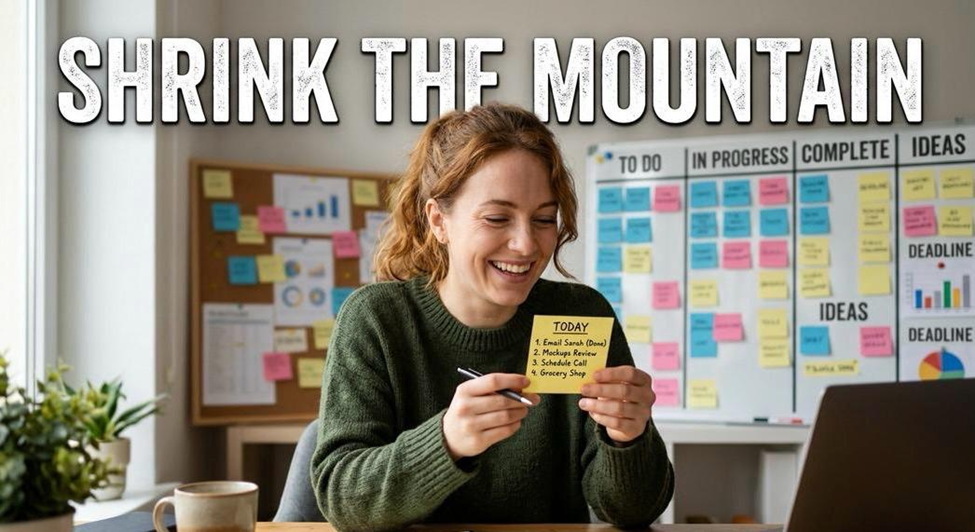
Massive goals carry heavy expectations. "Write a screenplay," "Launch a startup," or "Learn a new language" are terrifying mountains to stare at. When the brain perceives a task as too large, it triggers a freeze response. Procrastination sets in, not out of laziness, but out of sheer intimidation and fear.
To avoid this paralysis, the winner must be broken down into microscopic, almost laughably small pieces. Shrink the mountain until it looks like a pebble.
Instead of "launch a podcast," the task becomes "record a three-minute audio test on a phone." And instead of "write a novel," it shrinks to "write one single paragraph today." Instead of "build a website," the goal is simply "buy the domain name."
Small, consistent actions build undeniable momentum. In physics, Newton's First Law states that an object at rest stays at rest, and an object in motion stays in motion. The same applies to human creativity. Getting started is the hardest part, but once the wheels are turning, the momentum carries the project forward. Showing up for just five minutes often turns into an hour of deep, focused work.
The secret of highly prolific creators is that they never wait for motivation to strike. They know that action creates clarity, and momentum creates motivation.
On days when inspiration is completely absent, lower the bar. Just take the smallest possible step forward. A messy, imperfect start is infinitely more valuable than a perfect plan that never leaves the notebook. The first attempt will feel awkward and that’s okay. Let it. Lean into the clumsiness instead of fighting it.
A restless, curious mind is a beautiful, rare gift. Wanting to explore, build, and create is not a flaw to be fixed but rather, a superpower to be guided. The world does not require everything to happen all at once. It just requires a starting line.
The magic of life does not lie in having a thousand brilliant thoughts. The true magic lies in having the courage to pick just one, nurture it, and turn it into something real. So, if you have so many lingering ideas, choose one today. Stay with it. Give it room to grow. The rest can wait.

Why does your salary disappear so quickly? Explore the everyday spending habits, financial pressures, and small expenses that can turn ₦150,000 into a mid-month money crisis.
Why do we spend money trying to look successful? Explore the psychology behind lifestyle spending, social pressure, and the hidden cost of looking financially fine.
Learn how credit scores work, why they matter, and practical steps you can take to improve your credit score and make borrowing more affordable.