Discover how creative hobbies can enhance productivity, improve career performance, and increase your earning potential. Learn why investing time in creativity is a powerful strategy for financial growth and long-term success.
Why Having a Creative Hobby Makes You Wildly More Successful at Your Job
Let’s be honest for a second. How many times have we logged off, closed the laptop with a heavy sigh, and immediately migrated to the couch to scroll through a phone until bedtime? If that sounds familiar, know that it’s a shared experience in today's world. In this hyper-connected, always-on culture, there is a lingering belief that success requires dedicating every ounce of energy to a career. We listen to productivity podcasts at 1.5x speed while commuting and read books about optimizing morning routines, treating downtime as nothing more than a period to recharge for the next workday.
But what if I told you that the secret to getting that next promotion, solving that massive bottleneck at work, or finally feeling engaged with your career again has absolutely nothing to do with your job?
It sounds completely counterintuitive. We’ve been conditioned to view hobbies, especially creative ones as frivolous luxuries. Get comfortable, and let’s take a deep dive into exactly why stepping away from your spreadsheets and leaning into your creativity is the ultimate career hack.
The Myth of the Always-On Professional
Before we talk about why hobbies are so powerful, we need to talk about why we stopped doing them in the first place.
Somewhere along the line, the hustle culture narrative took over. The idea was simple but toxic: if you aren't grinding, you're falling behind. This mindset tells us that every hour must be monetized or optimized. If you like baking, you should start a side hustle selling cookies and if you enjoy writing, you should be building a personal brand on LinkedIn.
This constant pressure to perform has stripped the joy out of leisure, making us feel guilty for doing things just for fun. However, the human brain isn't designed to be a relentless productivity machine. Forcing it to be one leads to burnout, brain fog, and apathy rather than better results. Engaging in a hobby purely for the sake of doing it without any intention of putting it on a resume gives the brain a desperately needed break from the performance treadmill. Ironically, that mental space is exactly what’s required to perform at the highest level during work hours.
1. The Magic of Neuroplasticity: Rewiring Your Brain for Innovation
Let’s get a little bit nerdy for a moment and talk about what happens inside your head when you learn a new creative skill.
When you do the same type of work every single day, your brain becomes incredibly efficient at it. If you are an accountant, your brain builds super-highways for processing numbers. If you are a project manager, your brain builds super-highways for organizing timelines. This efficiency is great for getting your daily tasks done, but it comes with a hidden cost: cognitive ruts.
When you rely on the same neural pathways day after day, you start to approach every problem the exact same way. This makes you lose your cognitive flexibility and stop innovating.
When you sit down to learn how to play the guitar or figure out how to blend watercolours to make the perfect shade of sunset orange, you are forcing your brain to do something it hasn't done in a while and to build entirely new neural connections. This process is called neuroplasticity.
Neuroplasticity is the brain's ability to reorganize itself by forming new neural connections throughout life. For instance, when you engage in a novel, creative activity, you are essentially taking your brain to the gym. You are strengthening its ability to adapt, learn, and connect disparate ideas.
How does this translate to your job?
When you return to your desk on Monday morning after a weekend of painting or woodworking, your brain is physically different than it was on Friday. It is more agile and more primed to see connections between things that seem unrelated. When a complex problem arises at work, you are no longer stuck in your cognitive rut. You can approach the issue with the same "outside-the-box" thinking you used to solve a problem in your hobby and become the person in the meeting who suggests a completely different, innovative angle.
2. Active Recovery: The Ultimate Antidote to Burnout
We need to redefine what "rest" actually means.
When we are exhausted from work, our default setting is passive rest. We want to lie down, turn off our brains, and consume content. We scroll through social media, watch Netflix, or fall down YouTube rabbit holes.
While passive rest is sometimes necessary (we all need a good couch day now and then!), it is a terrible way to recover from chronic workplace stress. Passive rest doesn't replenish your cognitive energy; it just temporarily numbs your exhaustion.
Creative hobbies, on the other hand, offer something called active recovery.
Active recovery involves engaging in an activity that is different enough from your daily stressors that it gives your mind a break, but engaging enough that it requires your focus.
Think about it: if you are sitting on the couch watching a TV show, your mind is still free to wander. And where does it usually wander? Right back to the stressful email you got at 4:45 PM, or the presentation you have to give tomorrow. You are physically resting, but psychologically, you are still at the office.
Now, imagine you are throwing pottery on a wheel. If your mind wanders for even a second, your clay is going to collapse. You need to be present. You need to focus on the feeling of the wet clay, the speed of the wheel, the pressure of your hands.
This intense, focused engagement induces a psychological state known as "Flow" (a concept popularized by psychologist Mihaly Csikszentmihalyi). When you are in a state of flow, you are completely absorbed in the present moment. Hours can pass like minutes, and all the noise in your head just quiets down. It’s just you and what you’re doing.
Entering this flow state through a creative hobby forces a profound psychological detachment from work. It literally lowers your cortisol (stress hormone) levels and gives the parts of your brain that manage anxiety and executive function a chance to power down and heal. Active recovery does more than just reduce fatigue. It helps you return to your work feeling refreshed, recharged, and stronger mentally.
3. Cultivating the Beginner’s Mind and Embracing Failure
In the professional world, failure is terrifying.
We are conditioned to avoid mistakes at all costs. A mistake at work can mean a lost client, a missed promotion, a dressing-down from a boss, or a hit to our professional reputation. Because the stakes are so high, we naturally become risk averse. We stick to the things we know we are good at and decide to stay in our comfort zones.
But staying in your comfort zone is the fastest way to stagnate in your career. While growth requires risk, innovation requires the willingness to try something that might not work.
This is where a creative hobby becomes your secret weapon. A hobby provides a safe, low-stakes sandbox where you can practice failing.
The beginning of learning anything new is usually a little awkward. Your first attempt at baking sourdough bread might come out as a dense, inedible brick. When you start speaking a new language, you’ll probably sound a bit foolish. And in a beginner’s dance class, you may find yourself tripping over your own feet.
And you know what? It doesn't matter. Nobody is going to fire you because your sourdough didn't rise. You aren't going to lose a client because you painted an ugly picture of a bowl of fruit.
By engaging in a hobby, you are intentionally putting yourself in the position of being an absolute beginner. In Zen Buddhism, this is called Shoshin, or "beginner's mind." It refers to having an attitude of openness, eagerness, and lack of preconceptions when studying a subject, even when studying at an advanced level, just as a beginner would.
When you practice being a beginner in your hobby, you build emotional resilience. You learn that failure is not a reflection of your worth; it is simply data. It is feedback that tells you how to adjust your approach for the next attempt. Most importantly, you learn to laugh at your mistakes, iterate, and try again.
Bringing back this resilience to the office transforms how you work. You become less defensive when receiving constructive criticism and become more willing to volunteer for stretch assignments that intimidate you. Gradually, the fear of getting it wrong starts to fade, making room for bold, unconventional ideas to be shared more freely. Failure begins to look less like a setback and more like the first step toward true mastery.
4. Breaking Out of the Echo Chamber
Take a moment to think about the five people you spend the most time with. Chances are, they probably work in the same industry as you, or at least in a similar corporate environment.
If you work in tech, your world is filled with software engineers, product managers, and UX designers and let’s say you work in healthcare, you are surrounded by nurses, doctors, and administrators.
While it is great to have peers who understand your daily struggles, spending all your time in an industry bubble creates a massive echo chamber. You all read the same industry newsletters, use the same jargon, and approach problems from the same baseline assumptions.
Creative hobbies force you out of this bubble and thrust you into the beautiful, messy, diverse real world.
For instance, joining a local theatre production or a photography class introduces us to people from entirely different walks of life.
This cross-pollination of perspectives is incredibly valuable for your career. Innovation rarely happens when people who all think the same way sit in a room together. Rather, it happens when concepts from one field are unexpectedly applied to another.
Maybe you learn a fascinating lesson about team dynamics and non-verbal communication from your improv comedy troupe, and you apply it to how you manage your remote team at work. Maybe the patience and structural planning you learn from woodworking helps you design better software architecture.
Furthermore, these organic, low-pressure environments are often where the most authentic networking happens. When you build relationships based on genuine shared interests, you create a diverse, robust network that can support your career in ways you never anticipated.
5. Reclaiming Your Autonomy and Agency
Let’s face it: a lot of modern knowledge work can feel incredibly disjointed. You might spend weeks working on a single component of a massive project, never really seeing the final product come together. You need to navigate layers of bureaucracy, get approvals from three different managers, and compromise on your original vision to satisfy a client's demands.
Over time, this lack of autonomy can be deeply demoralizing. It leads to a phenomenon psychologists call "learned helplessness" (the feeling that no matter what you do, you don't really have control over the outcome). This is a fast track to disengagement and apathy at work.
A creative hobby is the perfect antidote to this feeling, because a hobby is a domain where you are the undisputed boss.
It can be refreshing to sit down and write a short story, where the entire world is yours to shape. The characters, the plot, and even the ending is all in your hands. Knitting a scarf can bring the same kind of freedom, choosing the yarn, the pattern, and the length without needing anyone’s approval. There’s no committee and no client, just your own creative vision guiding the process.
Reclaiming this sense of agency is incredibly empowering. It reminds you of your own capability. It gives you the deep, visceral satisfaction of taking raw materials and transforming them into a finished product with your own two hands.
This renewed sense of self-efficacy naturally bleeds into your professional life. When you remember that you are a capable, creative person who can execute a vision from start to finish, you carry yourself differently. With time, speaking up in meetings becomes easier and more confident. A stronger sense of ownership develops around projects, and the habit of waiting for permission slowly gives way to taking initiative.
Success Leaves Clues
If you are still sceptical that taking time away from work to play around with a hobby can make you more successful, let’s look at some of the most brilliant and accomplished minds in history.
Albert Einstein is perhaps the most famous example. When he was stuck on a complex physics problem, he didn't just sit at his desk and stare at the chalkboard until his eyes bled. He picked up his violin. He would play music for hours, allowing his conscious mind to rest while his subconscious mind worked through the mathematical equations. He famously stated that the theory of relativity occurred to him by intuition, and that music was the driving force behind that intuition.
Winston Churchill, who carried the weight of the free world on his shoulders during World War II, was an avid and passionate painter. He wrote extensively about how painting was the only thing that could completely clear his mind of the crushing anxieties of his political life.
In the modern business world, the trend continues. Marissa Mayer, the former CEO of Yahoo, is known for her elaborate, highly technical baking projects. Dick Costolo, the former CEO of Twitter, is passionate about beekeeping. Warren Buffett plays the ukulele. Meryl Streep is an accomplished knitter.
These highly successful individuals didn't achieve greatness in spite of their hobbies. They achieved greatness because of them. They understood that the human mind is not a battery that can just be recharged with sleep; it is a complex ecosystem that requires play, creativity, and diverse stimulation to thrive.
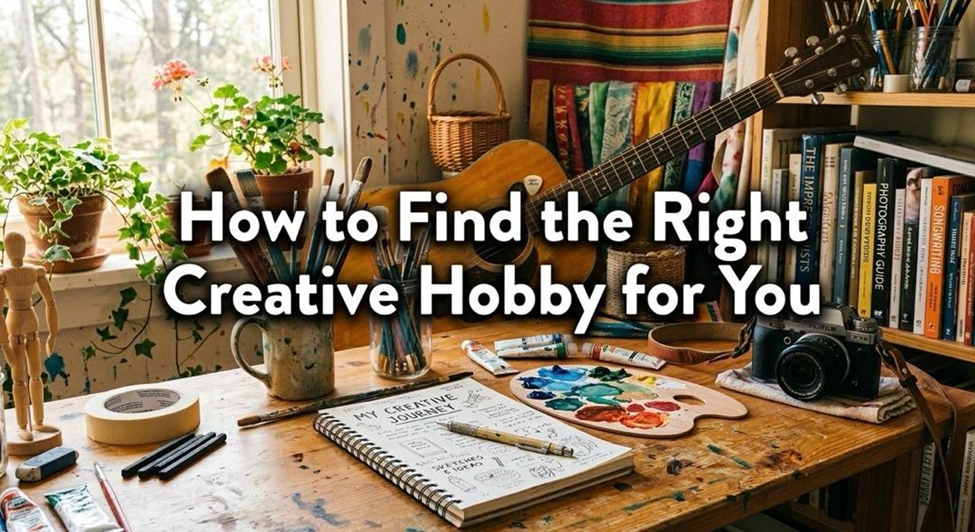
How to Find the Right Creative Hobby for You
Okay, so hopefully you are convinced that you need a creative hobby. But if you haven't had a hobby since you were in middle school, the idea of starting one now can feel overwhelming. Where do you even begin?
Try keeping a little corner of your life just for fun with no pressure to turn it into a side hustle. Let it be something you do simply because you enjoy it.
Pick something different from what you normally do. If you spend all day on a computer, try something hands-on like gardening or pottery and if your work is very analytical, play around with something creative like painting. Keep it simple. And most importantly, allow yourself to be bad at it. That’s half the fun, and honestly, that’s where the real joy lives.
Making Time
"I don't have time" is the most common hurdle, but it’s often a matter of making time rather than finding it. Reclaiming just two hours from the 10–15 hours many spend scrolling on phones each week is enough. Use the "15-Minute Rule" while coffee brews or protect a Sunday afternoon block with the same respect you’d give a meeting with a CEO.
In a corporate culture that often treats people like machines, the professionals who will thrive in the future are those who nurture their curiosity and aren't afraid to play. So, do your career a favour this weekend: close the laptop, turn off the notifications, and go paint a terrible picture. Your brain, your soul, and even your boss will thank you for it.
In a world filled with endless inspiration, having too many ideas can be just as paralyzing as having none. This article explores how to filter through the noise, identify profitable opportunities, and transform creativity into success.
Planning a trip with friends but worried about your finances? Discover practical budget travel tips, smart saving strategies, and stress-free ways to enjoy group adventures without going into debt. Travel smarter without sacrificing fun.
Learn how to save for your dream vacation without falling into credit card debt. Discover practical budgeting tips, smart saving strategies, and proven financial hacks for stress-free, debt-free travel.