You Were Paid Yesterday. What Happened?
Why does your salary disappear so quickly? Explore the everyday spending habits, financial pressures, and small expenses that can turn ₦150,000 into a mid-month money crisis.
Loading...

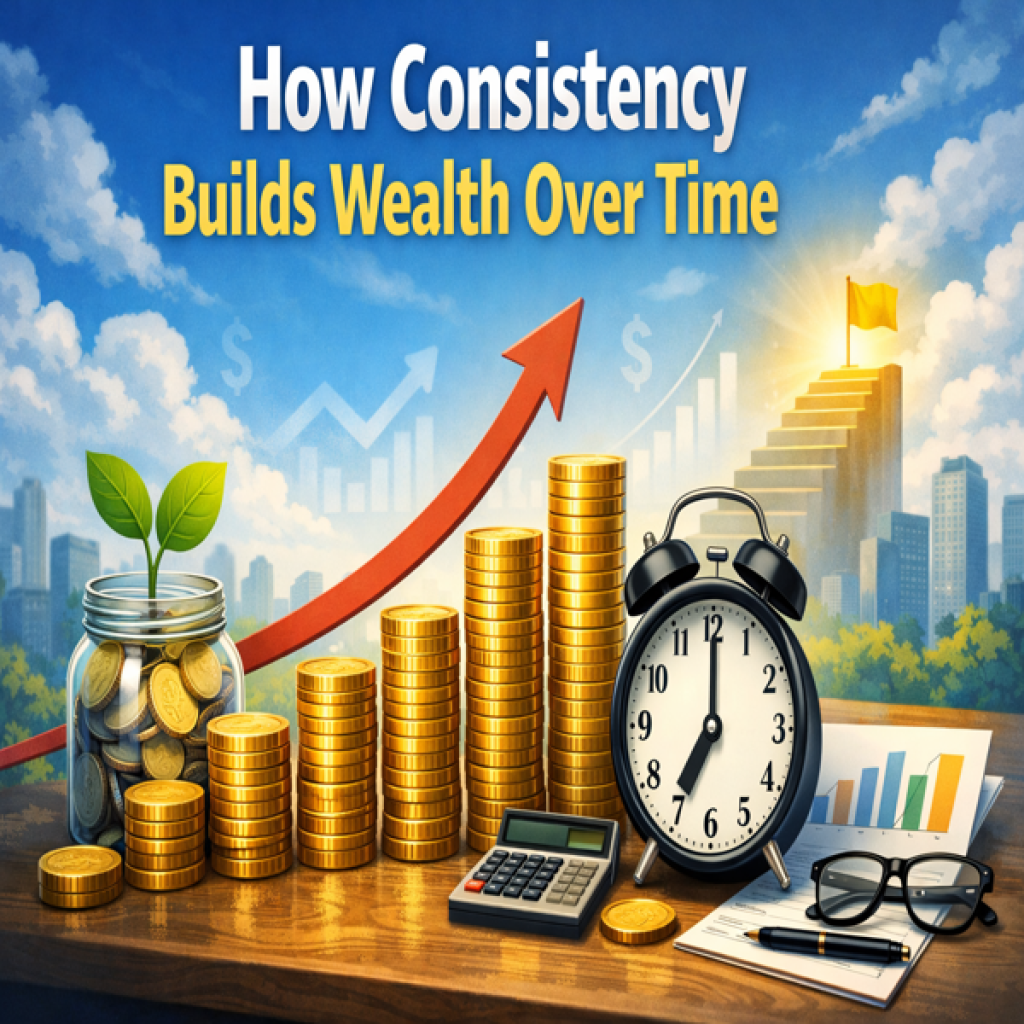
Consistency, not luck or sudden breakthroughs is the real driver of long-term financial success. Discover how small, steady habits can help you build wealth, avoid common money traps, and achieve lasting financial freedom.
Table of contents [Show]
If you spend more than five minutes on the internet today looking for financial advice, you will inevitably walk away feeling like you are doing everything wrong, and more importantly, that you are running out of time.
We are constantly bombarded by the noise of the spectacular.
The modern world has gamified money and turned the deeply personal, lifelong journey of building security into a high-speed spectator sport. And when you are sitting on your couch, looking at your perfectly normal bank account, trying to figure out how to pay for groceries and still put a little away for retirement, all this noise can make you feel incredibly inadequate. It makes you feel like there is a secret door to financial freedom, and everyone else was given the key except you.
But I want to tell you a truth that the internet algorithms absolutely hate. The secret to long-term financial success isn't a hack or a perfectly timed investment. It is simply consistency. The deep act of showing up, day after day, month after month, year after year, and doing the boring things right.
Let’s sit down and really talk about the actual human psychology of why consistency is the only financial strategy that works and why it is so incredibly hard for us to master.

To understand why consistency is so powerful, we first have to understand what we are fighting against. Human beings are biologically and culturally wired to look for the "Big Break."
Think about the stories we love to tell. We love the story of the struggling actor who gets cast in a blockbuster movie and becomes a millionaire overnight.
We are obsessed with the Big Break because it appeals to a very deep, very vulnerable part of our psychology. The Big Break promises salvation without the suffering of time. It promises that our financial anxiety can be cured in a single, sweeping moment of luck or genius.
But relying on the Big Break is a dangerous psychological trap. When you are constantly scanning the horizon for a massive windfall, you become paralyzed in the present and you start to view your daily financial decisions as meaningless.
You think to yourself, “What is the point of saving fifty dollars this week? Fifty dollars isn't going to change my life. I need fifty thousand dollars. I’ll just wait until I get that big promotion, or until my side hustle takes off, and then I’ll finally get my finances in order.”
This is the lie that keeps people broke. It is the belief that small amounts of money, and small amounts of effort, do not matter.
Consistency is the habit of making small, smart financial decisions repeatedly over time, even when the results don’t feel exciting yet. It forces you to respect the small numbers.
The reality of long-term financial success is that it is almost never the result of a single, dramatic event. Even the people who appear to have had an overnight success usually spent a decade quietly building the

If consistency is the key to wealth, why do so few people achieve it? If the formula is simply "spend less than you earn and invest the difference for a long time," why isn't everyone financially secure?
Because consistency is inherently, profoundly boring. And human beings absolutely hate being bored.
We are creatures driven by neurochemistry. When money is spent on something new, let’s say a fresh outfit, a new gadget, or a fancy dinner, it often comes with a little rush of excitement. That quick swipe of the card can feel surprisingly good. The brain releases dopamine, the chemical linked to pleasure and reward, so for a moment there is a boost of excitement. It can make a person feel good, confident, even a little more alive.
Now, compare that to the act of saving money.
When money automatically moves from a checking account into savings, it usually feels like nothing happened. No excitement or applause. No little rush of dopamine. If anything, there can even be a tiny sting, because that is money that can’t be used to enjoy something right now.
The same thing happens with long term investing. Putting money into a simple, diversified index fund and leaving it there for twenty years is honestly not exciting at all. It’s a bit like watching paint dry. You check the account, the number has moved a tiny bit, maybe just a fraction of a percent, and then you log out again.
This boredom is the ultimate filter. It is the great divider between those who build lasting wealth and those who spend their lives on a financial hamster wheel.
Most people cannot tolerate the silence of good financial habits. They start to feel restless because nothing exciting seems to be happening. And that’s often when they end up undoing their own progress.
For instance, someone might pull money out of a safe investment to chase a risky stock that promises quick gains. Or dip into their emergency fund to buy a car that makes them feel successful right now. Sometimes it’s even as simple as blowing a budget after a rough day at work because a shopping spree feels like the fastest way to feel better.
To achieve long-term financial success, you need to fundamentally rewire your relationship with boredom. You have to stop viewing boredom as a lack of progress, and start viewing it as the ultimate proof that your system is working.
Think of it like planting a tree. You dig the hole, you plant the seed, you water it, and then you wait. If you go out to the yard every single day and dig up the seed to see if it’s growing, you will kill it. The growth happens in the quiet, undisturbed dark.
Your money works the exact same way. You need to learn to fall in love with the quiet. You need to find peace in the fact that your financial life is not an action movie but rather, a slow, steady documentary. When you can sit with the boredom of consistency without feeling the urge to blow it all up just to feel a rush, you have mastered the hardest part of the game.
When we talk about consistency in finance, we usually talk about it in terms of compound interest. We talk about how money multiplies over time. But there is a much deeper, much more powerful type of compounding happening beneath the surface.
Consistency doesn't just compound your money. It compounds your identity.
Every action you take is a vote for the type of person you are becoming. When you make a budget and stick to it for a whole month, it’s not just about saving a few hundred dollars. It’s also a little moment where you prove to yourself, “Okay, I actually do what I say I’m going to do.” And that feels pretty good.
Same thing with the small choices. Let’s say you cook dinner at home instead of ordering takeout for the fourth night in a row. It might not feel like a huge deal, but it’s one more moment where you realize you do have discipline after all.
Over time, these small, consistent actions begin to shift the way you view yourself.
This is crucial, because most of our financial problems are rooted in our self-image. If you secretly believe that you are "bad with money," or that you are "destined to be broke," you will subconsciously act in ways that make those beliefs come true. Without even realizing it, it’s easy to start sabotaging your own progress. You will get a raise at work, and immediately inflate your lifestyle so that you are just as stressed as you were before.
But when you practice consistency, you slowly rewrite that internal narrative.
At some point, it stops feeling like something you’re trying to do. Instead of being someone who is trying to save money, you slowly become someone who just saves. It becomes part of how you live. The same shift happens with debt. Instead of constantly feeling like you’re trying to get out of it, you start to see yourself as someone who handles money responsibly.
This identity shift is the ultimate armor against the chaos of the world. When your identity changes, good financial decisions no longer require massive amounts of willpower. They slowly become part of who you are.
This is why the people who achieve long-term financial success carry themselves with a certain kind of quiet confidence. It is because they have spent years building a deep, unshakable trust in themselves. They know that whatever happens in the economy, whatever happens in the job market, they have the internal discipline to navigate it.
That kind of confidence isn’t something money can buy, and it’s not something anyone can hand over to you. The only way it shows up is by building it slowly over time, through the small, consistent choices you make every day. It’s not glamorous, but little by little, those steady habits start stacking up and turning into real confidence.

There’s a part of this journey that almost everyone goes through, and it’s what I like to call the messy middle. It’s that stage where you’re trying to build better habits with money, but things still aren’t perfect. Some months you stay on budget, other months you overspend. Sometimes you make great decisions, and sometimes you look back and think, “Why did I buy that?”
And that’s exactly where a lot of people get discouraged. They think the mistakes mean they’re failing. But the truth is, the messy middle is a completely normal part of learning how to handle money better. It’s where most of the real growth actually happens.
We imagine consistency as an unbroken, perfectly straight line pointing up and to the right. We think that if we are truly consistent, we will never overspend, we will never make an emotional purchase, and we will never have a month where we must dip into our savings.
But you are a human being, living a messy, unpredictable human life.
You are going to have months where everything goes wrong. Your car will break down the same week your dog gets sick. You will have a day where you are so emotionally exhausted, so burnt out, and so overwhelmed that you order fifty dollars’ worth of sushi and buy a sweater you don't need just to feel a tiny sliver of joy. You will set a budget on the first of the month, and by the twelfth of the month, it will be completely destroyed.
When this happens, the perfectionist mindset will tell you that you have failed. It will tell you that your streak is broken, that you are back to square one, and that you might as well just give up and go back to your old habits.
This is the moment where true consistency is forged.
Consistency is not the absence of failure. Consistency is the refusal to let a temporary failure become a permanent derailment.
Think of consistency not as a tightrope that you have to walk perfectly, but as a gravitational pull. When you stumble and drift off course, consistency is the force that gently but firmly pulls you back to your center.
If you eat a terrible, unhealthy meal on a Tuesday, you don't assume your health is ruined forever and decide to eat garbage for the rest of the year. You just wake up on Wednesday and drink a glass of water. You return to baseline.
Your money requires the exact same grace. If you blow your budget in October, you do not carry that shame into November. You sit down, you look at what happened without judging yourself, you forgive yourself for being a flawed human being, and you start again.
The people who win in the long run aren’t the ones who never mess up. They’re the ones who know how to bounce back quickly. They don’t spend weeks beating themselves up over one bad money decision. They take a breath, tweak the spreadsheet, maybe roll their eyes at themselves a little, and get right back to the boring but important stuff.
They get that a bad week, a messy month, or even a rough year isn’t the end of the story. In the bigger picture of a whole lifetime, it’s just a tiny bump in the road. And the best thing to do is keep moving.

Whenever I find myself getting impatient or when I look at my accounts and think, “This is taking too long” I remind myself of two people.
The first is Ronald Read. He worked as a gas station attendant and a JCPenney janitor in rural Vermont. He drove a second-hand car and chopped his own firewood. Yet, when he passed away at 92, he left behind an $8 million fortune. He didn’t win the lottery or invent an app. He just consistently took whatever small amount he could spare, bought boring blue-chip stocks, and let time do the heavy lifting for decades.
The second is Warren Buffett. We think of him as a financial wizard, but his real superpower is simply his timeline. Buffett started investing at age ten. Today, he’s in his nineties. The most mind-blowing fact about his $130 billion fortune? Over 95% of it was generated after his 65th birthday . His secret wasn't just making good decisions; it was making good decisions and refusing to interrupt them for eighty years.
One was a janitor, the other a billionaire icon. But they both used the exact same vehicle: they didn't chase the Big Break. They just stayed in the game.
When you’re standing at the very beginning of a financial journey and looking at a goal that’s five, ten, or even twenty years away, it can feel a little intimidating. The distance alone can make it seem like a huge mountain to climb.
It’s easy to start thinking things like, “Ten years to pay off this debt?” or “Twenty years to build a solid retirement fund? " That's forever.” And suddenly the whole thing feels so far away that it’s tempting not to start at all.
But here’s the funny thing about time. It will pass anyway.
Ten years from now will show up whether you start today or not. The real question is simple: when that day arrives, will you be glad you started or wishing you had?
If you continually choose consistency, something amazing starts to happen. And seriously, you might wake up one day and barely recognize the life you’ve built.
Those tiny decisions that once felt almost invisible slowly turn into something solid and secure. It’s like quietly building a fortress around yourself and the people you care about.
And the funny part is, it’s not just your bank account that changes. Somewhere along the way, you change too.
So first, take a little pressure off yourself. You don’t have to be some kind of financial genius to get this right. And honestly, constantly looking at what everyone else is doing on the internet doesn’t help either. Their timeline isn’t yours.
There’s also no need to wait for the perfect moment, the perfect salary, or the perfect market conditions. Those “perfect” situations have a funny way of never actually showing up.
Just start.
Make one good decision today. Tomorrow, make another one. Keep stacking those small choices and let consistency quietly do the heavy lifting in the background.
It won’t be loud. It won’t look glamorous. No one is going to throw confetti because you stuck to your budget or invested another $100. But one day you’ll look back at the life you’ve built and realize something pretty cool: the quiet work you kept showing up for turned into one of the biggest wins of your life.

Why does your salary disappear so quickly? Explore the everyday spending habits, financial pressures, and small expenses that can turn ₦150,000 into a mid-month money crisis.
Why do we spend money trying to look successful? Explore the psychology behind lifestyle spending, social pressure, and the hidden cost of looking financially fine.
Having enough money to buy something doesn’t always mean you can afford it. Learn a smarter way to evaluate purchases, protect your finances, and spend with confidence.