You Were Paid Yesterday. What Happened?
Why does your salary disappear so quickly? Explore the everyday spending habits, financial pressures, and small expenses that can turn ₦150,000 into a mid-month money crisis.
Loading...


Discover how your financial identity shapes your money habits and wealth. Learn why mindset, not math, is the real key to building lasting financial success.
Table of contents [Show]
Most people approach money as if it were a simple math problem. They believe that if they just had a better calculator, a more disciplined spreadsheet, or a higher salary, their financial woes would vanish. They spend years obsessing over the "how", the apps, the budgeting software, and the daily habit of cutting out small luxuries while ignoring the silent engine driving every decision they make which is their financial identity.
If you are currently trapped in a cycle of earning and immediately losing, or if you find yourself paralyzed by the thought of checking your bank account, you aren't suffering from a lack of math skills. You are suffering from an identity misalignment.
To build true wealth, you must stop trying to patch your habits and start changing who you believe you are in relation to your resources.
Let’s break this down together.

We like to think we are logical creatures. We tell ourselves that we want to save, invest, and reach financial independence. But why is it that, despite knowing exactly what to do, we still sabotage our efforts?
It is because your brain is wired to act in accordance with your internal narrative. If you secretly believe, "I am someone who is always broke," your brain will find a thousand clever ways to ensure your bank account stays empty to match that identity. You can give a person a million dollars, but if they have the identity of someone who is "always struggling," that money will evaporate in a matter of months. This is the simple power of mindset, it starts from your mindset, and it is the believe that makes things that seem impossible become possible. It is better to try and fail, than not attempting at all. Financial success is linked to a positive mindset, the ‘I can make it happen mindset’
Financial success is not a sprint; it is an architecture. It requires building a foundation of beliefs, a structure of habits, and a system of execution. Today, we are going to dismantle the old version of your financial self and start the construction of an identity that is built to last.
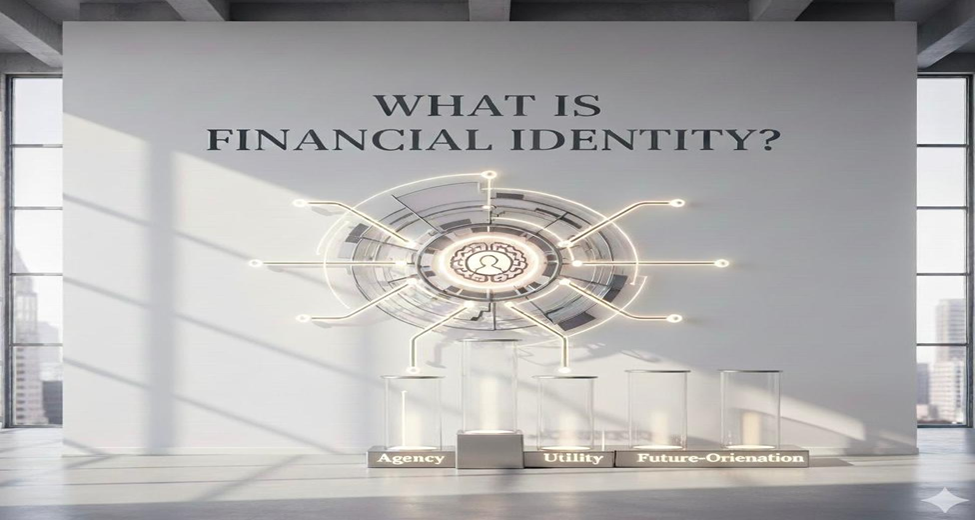
Agency is the deep, unwavering belief that you are the architect of your financial outcomes, not a helpless victim of the economy. People with low agency say things like, "The system is rigged, so why bother trying?" or "I'll never be able to afford a house, so I might as well buy this $500 jacket." People with high agency look at a rigged system and say, "This is difficult, but I am capable of navigating it. I am at the steering wheel of my life."
Pillar 2: Utility (The Hammer Mindset)
Utility is the understanding that money is simply a tool to be engineered for specific goals, not a metric of your human self-worth. When you have a broken financial identity, you use money as a mirror. If you have a lot of it, you feel superior; if you have a little, you feel worthless. When you have a healthy identity, you view money like a hammer. A hammer isn't "good" or "bad." It doesn't make you a better person. It's just a tool you use to build a house.
Pillar 3: Future-Orientation (The Time Traveler Mindset)
This is the capacity to value your future self as a real, living, breathing person who deserves your current capital investment. People who struggle with money view their future self as a stranger. They think, "That's a problem for a 60-year-old me to figure out." People who build wealth have deep empathy for their future selves. They view saving money not as a punishment for their current self, but as a generous gift to the person they are becoming.
If you don't define your financial identity, the world will define it for you and usually as a "consumer." You must consciously choose to become a "steward" and a "builder."
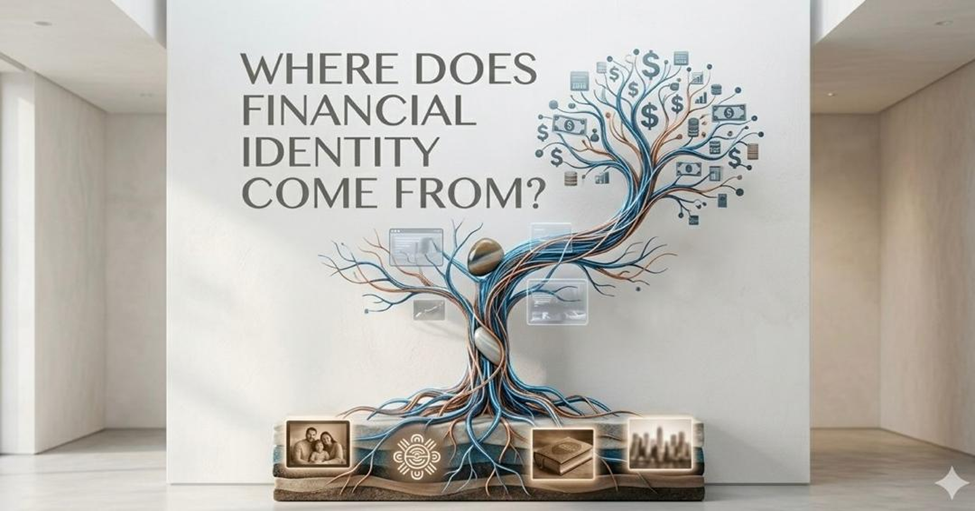
I need you to give yourself some grace right now, because your current financial identity didn’t just appear out of thin air. You didn't choose it. It was forged in the reality of your early life, your environment, and your traumas.
Most of us formed our very first financial blueprints before we were even ten years old. We didn't learn about money from textbooks; we learned by watching the adults around us.
Think back to your childhood. What happened at the kitchen table when the mail arrived? Did your parents open bills with a sense of calm, or was there a sudden tension in the air? Did they fight about money behind closed doors? Did you hear phrases like, "Money doesn't grow on trees," or "Rich people are greedy," or "We can't afford that, who do you think we are?"
Even if your parents never spoke a single direct word to you about finance, their behaviors taught you a narrative. If you grew up in a household where money was a constant source of scarcity, anxiety, and conflict, you likely developed a "fear-based" identity. You learned that money is dangerous, fleeting, and stressful.
As we grow up, the culture takes over where our parents left off. We are constantly, relentlessly fed a narrative that our human value is directly tied to what we own. From the clothes we wear, to the cars we drive, to the aesthetic of our apartments on Instagram, society pushes a "spender identity."
The algorithm tells us that being low on cash, or feeling sad, or feeling inadequate, is a temporary state that can be instantly fixed by buying just one more thing to look the part. We are trained to soothe our emotional wounds with consumerism.
Finally, our own past failures leave deep, invisible scars. The bad investments, the missed rent payments, the suffocating debt traps, the humiliation of having a card declined at the grocery store, these moments traumatize us.
Instead of viewing these events as temporary mistakes, we internalize them as permanent proof of our inability to handle money. We take a situational circumstance (a period of low liquidity) and we mutate it into a personality trait ( "I am just bad with money" ).
Recognizing that your current identity is a learned behavior is the most empowering realization you can possibly have. Why? Because if it was learned, it can be unlearned. You are not broken. You are just running old code.
The reason you keep repeating the same financial is that your behavior is simply a reflection of your identity. If you identify as an operator. Someone who views money as a resource to be managed through systems, your behavior shifts automatically.
Your identity acts as a continuous feedback loop. If you label yourself as "bad with money," your brain will treat every financial decision through the lens of that label, searching for confirmation of your incompetence. You will highlight your mistakes and ignore your successes. Conversely, if you identify as a "Resource Manager," you treat a financial error not as a character flaw, but as a data point—a piece of information that helps you refine your system for next time.
Also, when you try to adopt a new financial habit like tracking your expenses or automating your savings but it conflicts with your old identity, you experience "identity dissonance." This is that uncomfortable, itchy feeling that makes you want to quit. You feel like a fraud. You feel like you’re living a life that doesn’t fit.
Most people mistake this internal discomfort for evidence that they are "not meant for this." In reality, this discomfort is simply the feeling of an old, inefficient identity dying off to make room for a more effective one. It is completely normal to have this discomfort, but it fades off with time. It is more important to keep strongly to the new financial behaviour as it leads to your financial freedom.

So, how do we actually rewrite the software? How do we stop being the "anxious spender" and become the "calm architect"?
Author James Clear writes in Atomic Habits that every action you take is a vote for the type of person you wish to become. If you want to be a master of your finances, you don't just declare it; you perform the micro-actions of one, day after day, until your brain has no choice but to believe you.
You don’t do it by standing in front of a mirror and repeating positive affirmations. If you stand in the mirror and say, "I am a millionaire wealth builder," while your bank account is overdrawn, your brain is going to call your bluff. Your brain requires proof.
You change your identity through the relentless accumulation of small, undeniable evidence.
For instance, you learn to move a small amount into a separate account or audit your subscriptions and cancel the very ones you don't need. Every single time you perform one of these tiny acts, you are casting a vote for the person you are becoming. You are laying a brick in the architecture of your new wealth by building a resume of proof that your brain cannot ignore.
So, in summary, if you really want to build wealth, you have to start by changing how you see yourself with money. A lot of people think wealth is just about earning more or finding the perfect budget, but the truth is your financial habits usually follow the identity you have about money. The structure of your financial life is built on the foundation of your beliefs and mindset. If you see yourself as someone who is always struggling financially, your actions will keep reinforcing that. But when you start seeing yourself as someone who manages resources wisely, your behavior begins to change too.
That’s what it really means to become the architect of your wealth.
So, what will your next act of evidence be?

Why does your salary disappear so quickly? Explore the everyday spending habits, financial pressures, and small expenses that can turn ₦150,000 into a mid-month money crisis.
Why do we spend money trying to look successful? Explore the psychology behind lifestyle spending, social pressure, and the hidden cost of looking financially fine.
Having enough money to buy something doesn’t always mean you can afford it. Learn a smarter way to evaluate purchases, protect your finances, and spend with confidence.