You Were Paid Yesterday. What Happened?
Why does your salary disappear so quickly? Explore the everyday spending habits, financial pressures, and small expenses that can turn ₦150,000 into a mid-month money crisis.
Loading...

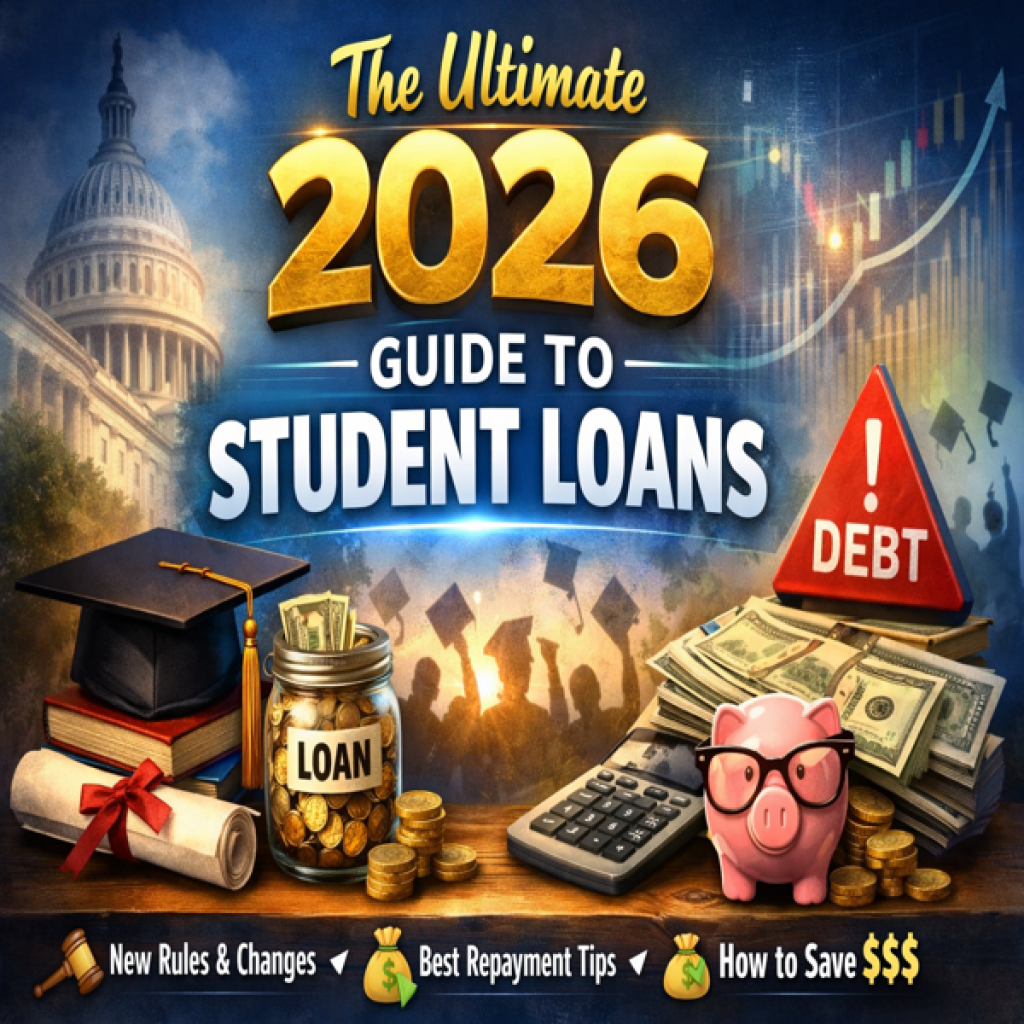
Thinking about taking a student loan in 2026? This beginner-friendly guide breaks down your best options, hidden costs, new legal changes, and smart strategies to avoid debt traps and save thousands.
Table of contents [Show]
Let’s be real for a second. Opening your student loan portal feels a lot like opening a bill from a restaurant where you don’t remember eating, and you’re pretty sure they overcharged you for the tap water.
If you feel a cold, heavy knot in your stomach every time you see an email from the "Department of Education" or your loan servicer looking at you, take a deep breath. You are not alone. In fact, you are in the majority.
For most of us, student loans were the very first major financial contract we ever signed. Think about how wild that is. You were probably 18 years old. You had to ask permission to go to the bathroom during the third period. You couldn't legally buy a beer, rent a car, or even adopt a golden retriever from the local shelter because you lacked demonstrated responsibility. But the government and private banks looked at you and said, "Hey kid, want $80,000 at 6.8% interest to study 14th-century French literature? Sign here."
Now, here you are, trying to navigate actual adulthood. You’re trying to buy groceries that aren't ramen, maybe save for a house, or just go to a friend's wedding without going into credit card debt. And this giant mountain of student loan debt is sitting in the corner of your life like an uninvited, incredibly expensive roommate who refuses to move out.
But here is the good news; You have way more control over this than you think.
In this massive, friend-to-friend guide, we’re going to break down the confusing jargon, look at the actual math, navigate the wild new 2026 legal changes, and help you pick a plan that lets you sleep at night. Grab a coffee (if you can still buy coffee), and let's get into it.

When we talk about personal finance, human beings are obsessed with the big numbers. We fixate on the total balance. "I owe $40,000!" or "I owe $150,000!"
But in the world of student loans, the strategy you use to pay it back is infinitely more important than the balance itself.
Think of paying off debt like running a marathon. If you sprint the first mile as fast as you can, you’re going to collapse by mile three, vomit on your shoes, and quit. If you walk too slowly, you’ll be on the course for three days and everyone will have gone home. You need a pace that fits your specific lung capacity.
In financial terms, your "lung capacity" is your cash flow (the money you have left over after paying for your basic survival).
A repayment plan that takes 60% of your pay-check might get you out of debt faster on a spreadsheet, but if you can’t afford rent, groceries, or a co-pay at the doctor, that’s not a strategy; rather, that’s a financial crisis waiting to happen. On the flip side, a plan that costs $0 a month might feel like a massive relief today, but if the interest is ballooning behind the scenes like a science fair volcano, you’re just building a bigger, scarier mountain for your future self to climb.
Strategy means finding the sweet spot between paying the debt down and living your life.
Before we dive into the "which one is best for me" debate, we need to understand what’s actually on the menu. The federal government offers several ways to pay back your loans. Let’s break them down without the confusing government speak.
This is the default setting. If you graduate, ignore all the emails, and don't actively choose a plan, the government automatically puts you on this one.
How it works: You pay a fixed, unmoving amount every single month for exactly 10 years (120 payments). The payment does not change during that time, so you always know exactly how much you owe each month. Because the amount stays the same from the first payment to the last, it makes budgeting easier and gives you a clear timeline for when your loan will be completely paid off.
The Math: It’s the shortest route to being debt-free (other than winning the lottery and paying it all off in a lump sum). Because you pay it off relatively quickly, you pay the least amount of interest over the life of the loan.
The Catch: The monthly payments are usually the highest. If you’re a fresh grad making an entry-level salary of $45,000, a $600/month Standard payment can feel like a chokehold on your budget.
Best for: People with a stable, high income right out of the gate who want to be done with debt ASAP and hate the idea of paying extra interest.

This plan operates on a very specific assumption that you are going to make way, way more money in five years than you do today.
How it works: Your monthly payments start out low at the beginning, sometimes so low that they only cover the interest building up on the loan that month, and very little of the actual loan balance. This can make the first few years feel easier because the payments are smaller. However, the payment does not stay low forever. Every two years, the amount you pay automatically increases. The idea behind this plan is that your income will likely grow over time, so the payments gradually rise as your earning power improves. Even though the payments start small and increase along the way, the plan is still designed so that the entire loan is fully paid off within 10 years.
The Math: It gives you vital breathing room right when you're broke, but those automatic payment jumps every two years can be incredibly jarring if your salary hasn't gone up.
The Catch: You will pay more in total interest than the Standard Plan because you’re not chipping away at the principal (the actual core amount you borrowed) very much in those early years.
Best for: People in careers with very clear, guaranteed, steep salary ladders (like junior associates at law firms, medical residents, or union apprentices).
If your federal debt is more than $30,000, the government allows you to stretch your payments out over 25 years instead of 10.
How it works: You can choose either fixed payments (same amount every month) or graduated payments (starts low, gets higher), but the timeline is stretched across two and a half decades.
The Math: This drastically lowers your monthly payment. It’s the difference between paying $600 a month and $250 a month. It frees up your monthly cash flow immediately.
The Catch: Interest is the silent killer here. By stretching a loan to 25 years, you are giving the interest 15 extra years to compound. You might end up paying back double what you originally borrowed.
Best for: People who desperately need the lowest possible monthly payment to survive their current budget, but who make too much money to qualify for Income-Driven plans.

This is where things get interesting and a little complicated. IDR plans don't care how much you owe; they only care how much you make.
How it works: Your payment is calculated as a percentage (usually 5% to 10%) of your "discretionary income." (Discretionary income is a fancy math formula which is your Adjusted Gross Income minus a percentage of the federal poverty guideline for your family size). If you don't make much money, your payment could literally be $0 a month, and it legally counts as an on-time payment.
The Math: After 20 or 25 years of making these payments, any remaining balance on your loan is completely forgiven. Wiped out. Gone.
The Catch: You need to recertify your income every single year. You need to send them your tax return to prove what you make. If you forget to do this, your payments can skyrocket back to the expensive Standard rate overnight.
Best for: Almost everyone else. Especially those pursuing Public Service Loan Forgiveness (PSLF), or those whose total debt is much higher than their annual salary.

Most people choose a repayment plan out of pure panic. Some go with the lowest payment possible because they’re scared, they won’t have enough money to survive. Others rush to pay everything off immediately because they feel guilty about having debt and think it’s something terrible that must disappear right away.
To be a strategic borrower, you need to take the emotion out of it for twenty minutes and look at three specific numbers in your life.
Take your total student loan balance and compare it to your annual pre-tax salary.
If your debt is LOWER than your salary (e.g., you owe $30k and make $60k): You can probably handle the Standard Plan or a Graduated Plan. You are in a strong mathematical position to get aggressive, pay it off, and get it out of your life.
If your debt is HIGHER than your salary (e.g., you owe $90k and make $50k): You should almost certainly be looking at an Income-Driven Repayment (IDR) plan. Trying to pay off $90k on a $50k salary using the 10-year Standard Plan is a recipe for absolute burnout. You will have no money for emergencies, retirement, or joy.
Before you decide to be a hero and pour every extra cent of your pay-check into your loans, ask yourself a dark but necessary question: If my car transmission blew up tomorrow, or my company did layoffs next week, do I have cash in the bank to survive?
If the answer is no, you should not be on the aggressive Standard Plan. You should take a lower monthly payment plan and use the extra money in your budget to build a $1,000 to $3,000 emergency fund first.
Listen to me closely: Debt is a problem, but a total lack of cash is an emergency. You cannot pay your rent just because you’re doing a good job paying your student loans. Build your cash runway first.
Are you in a field where you qualify for Public Service Loan Forgiveness (PSLF)? If you work for a 501(c)(3) non-profit, a public school, a hospital, or any level of government, your strategy changes completely.
If you qualify for PSLF, your goal is not to aggressively pay off your student loans. Instead, the strategy is to pay the lowest monthly amount you are legally required to pay for 10 years (120 payments) while working in public service until the government wipes the rest away tax-free. If you are going for PSLF, you want an Income-Driven plan, and you want your payment as low as humanly possible.
Paying off student loans is a grind. It is a marathon run in the mud. There will be months where you feel like you are throwing money into a black hole, and there will be months where you want to give up and just buy the expensive car anyway.
But I want you to imagine what your life looks like the month after you make that final payment.
Imagine your pay-check hitting your bank account on a Friday morning. You pay your rent and buy your groceries. And then, nothing else comes out. That $400 or $600 that used to go to the Department of Education? It just sits there. It's yours. You can invest it, you can save it for a house, or you can book a flight to Mexico.
That is what you are fighting for. So, pick a strategy. Audit your cash flow. Set up your safety nets. And then put your head down and get to work. You’ve got this.

Why does your salary disappear so quickly? Explore the everyday spending habits, financial pressures, and small expenses that can turn ₦150,000 into a mid-month money crisis.
Why do we spend money trying to look successful? Explore the psychology behind lifestyle spending, social pressure, and the hidden cost of looking financially fine.
Having enough money to buy something doesn’t always mean you can afford it. Learn a smarter way to evaluate purchases, protect your finances, and spend with confidence.