You Were Paid Yesterday. What Happened?
Why does your salary disappear so quickly? Explore the everyday spending habits, financial pressures, and small expenses that can turn ₦150,000 into a mid-month money crisis.
Loading...

Your salary isn’t missing, you spent it. Learn where your money really goes, why it disappears so fast, and how to finally break the paycheck-to-paycheck cycle.
There’s a particular kind of heartbreak that happens two weeks after payday.
You are not even doing anything dramatic. Maybe you’re just casually checking your account balance. Maybe you’re about to transfer money or pay for something small. You open your banking app confidently and then you freeze. Something doesn't add up. Suddenly you feel a cold pit in your stomach. "Where did it all go?" you ask yourself. "Did I get hacked? Did the bank make a mistake? Surely, I couldn't have spent that much."
The feeling is universal. It feels like theft. It feels like a mistake. But the hard truth is this: Your salary wasn't stolen. It died a death of a thousand cuts.
In today’s blog, we are breaking down exactly where your money goes, why it disappears so fast, and how to stop the cycle permanently. It may not be easy to accept, but it’s the first step toward financial control.
1. The Mystery of the Vanishing Paycheck
Let's talk about paychecks. The money you earn for the work you do. Think of it as the reward for showing up, putting in the hours, and completing your responsibilities. It’s supposed to give you security, freedom, and the ability to cover your needs and maybe even a little fun.
But for many of us, that feeling doesn’t last long because, a few days (or sometimes just hours) after receiving it, we open our bank app and our balance is lower than expected. And that’s when the “mystery” starts:
Where did all the money go?
We tend to think of "spending" as big, memorable events: buying a new phone, booking a flight, or paying rent. But money rarely leaves our accounts in giant, memorable chunks. Instead, it leaks out in a thousand tiny, forgettable trickles. Let’s break down further.
You’ve probably heard the term The Latte Factor before. It comes from the idea that small, seemingly harmless daily purchases like a coffee or snack can quietly drain your money if you do them consistently. The term comes from literally buying a latte every day, but it applies to any small, repeated spending that feels routine.
For example:
A ₦1,500 coffee every morning
A ₦3,500 lunch salad or small meal
₦2,000 for snacks during work breaks
On their own, these feel harmless. They barely register as spending. But multiply that by 20–25 days a month and suddenly you’ve spent over ₦100,000. It might seem harmless, but over a month, it’s basically the same as buying a month’s worth of groceries for some people.
The Latte Factor isn’t just about coffee. It’s about mindless habits. When small spending is automatic and unchecked, your salary leaves without you realizing it. You feel fine when you spend a little, so you don’t think about the bigger picture. By the end of the month, the accumulation is huge, and your balance looks smaller than it should. Honestly, It is not “bad” to spend on yourself but rather, it is bad if spending is unconscious and uncontrolled. The Latte Factor highlights the difference between intentional spending and habit spending.
Understanding this can teach you control and awareness of your salary/paycheck. You now notice where your money goes, decide what daily or small purchases are worth it to you and are able to recognize which habits are quietly eating up your salary.
If you track it and make intentional choices, the same coffee habit can exist without secretly draining your pay.
Subscription Fatigue: The Sneaky Salary Drainer
Subscription Fatigue is what happens when we’re paying for a bunch of services, apps, or “free trials” that we barely use or sometimes don’t even remember signing up for.
Think about it. You have Netflix, a few music streaming apps, maybe cloud storage, and a design app or two. At first, it felt useful, convenient and worth it. But over time, many of these services just sit there, quietly charging your account every month while you barely open them.
That’s the fatigue part. The mental exhaustion of realizing later that money is leaving your salary for things you don’t even use. You don’t notice it at first because each payment is small and automatic. You don’t think twice when the bank deducts it. But it adds up silently, and it chips away at your paycheck.
i. Check your statements monthly: Look for recurring payments you don’t use.
ii. Cancel what you don’t need: Don’t feel guilty; if it’s not serving you, it’s just money lost.
iii. Ask yourself before subscribing: Is this really useful, or just something that’ll sit unused?
Subscription Fatigue is a classic example of habit spending: money leaves automatically, without awareness. The difference is, once you notice it, you can stop it immediately and reclaim that portion of your salary.
2. The Psychology of "I Deserve It"

There’s a universal mental pattern behind many of our purchases, especially the ones we do not plan. It’s the internal voice that whispers, “I deserve this.” Maybe it came after a stressful day, a small win, or even just the feeling of “I have earned it.” This mindset isn’t inherently wrong. Sometimes treating yourself is healthy, motivating, and definitely deserved. The problem isn’t the reward but how often and why we reach for it.
To understand this better, let’s break down what’s really happening inside our heads when we spend time with words like “deserve,” “need,” or “just this once.”
Emotional Spending
Emotional spending is when you buy something not because you need it, but because you are trying to change or manage the way you feel. It’s spending driven by emotion rather than necessity or logical budgeting. This type of spending happens outside of real financial planning and it’s mostly a reaction, not a decision.
A good way to understand it comes from psychology research, where emotional spending is described as buying to “cope with negative feelings or enhance positive ones,” rather than to satisfy a practical need.
Emotion‑driven spending happens when money is used to change how we feel. For instance, ordering food delivery after a frustrating day, buying clothes or accessories when you feel bored or how about this; Impulse purchases after seeing something online that sparks joy.
This type of spending isn’t based on real financial need. It's based on emotional comfort. The trouble is, while a purchase might make you feel good in the moment, it rarely solves what you’re actually feeling. One small purchase leads to another, and before long, your account balance looks smaller than you expected.
The problem isn’t just financial, it's psychological. Emotional spending gives a short-term moodboost, but it does not solve the underlying emotion.
i. Feeling stressed? Buying something makes you feel better for a few minutes.
ii. Feeling bored or lonely? Shopping distracts you briefly.
Sometimes, once the effect fades, the original emotion returns often stronger and the brain nudges you toward another purchase. This creates a loop of spending to feel better, which can easily become habitual.
The Dopamine Hit
Have you noticed how exciting it feels to order something online, click “Pay Now,” or get a delivery notification? That rush, that little thrill. That's dopamine at work.
Dopamine is a chemical in your brain that makes you feel pleasure. It’s released when you anticipate a reward or do something enjoyable. Buying something new triggers this chemical, which is why your brain loves spending even if the item itself ends up sitting unused. Here's the interesting part; research shows that the anticipation of getting something often gives more pleasure than actually having it.
Spending money to feel good is normal. Treating yourself after a long day or celebrating a win is fine. The problem arises when it becomes the default way to manage your emotions, the stress, boredom, anxiety, or even loneliness. Some people start showing patterns that look almost like addiction. Every time your brain gets that dopamine rush from buying something, it rewards the behavior. That means your brain learns that spending equals pleasure. Over time, you start buying more often small items you do not truly need. For instance: Small impulsive buys of ₦500, ₦1,000, or ₦2,000 feel harmless individually. But repeated over weeks or months, they quietly eat into your salary without you noticing.
While we can't really wave off the dopamine effect because it is just doing its job, rewarding us for things that feel good, we can outsmart it. The goal isn’t to stop enjoying purchases or treats; it’s to make your money and your emotions work together, instead of letting impulse spending control your salary.
Here's what you can do;
a. Pause Before Buying
When that “I want it now” feeling hits, take a deep breath and wait. Even a few hours or a day can help. Often, the urge fades, and you’ll realize whether you actually need the item or if it’s just the thrill talking.
b. Ask Yourself the Right Questions
Before making a purchase, check in with yourself:
Am I buying this to feel better, or because I truly need it?
Is there a free or cheaper way to get this same excitement?
These questions turn impulse into intention, giving you control over where your salary goes.
c. Plan Your Rewards
It’s okay to treat yourself. Budget small, meaningful rewards or plan purchases around celebrations and achievements. This way, you get the dopamine boost intentionally without letting your money vanish unnoticed.
d. Notice Your Patterns
Reflect on your past spending. Do you often buy when stressed, bored, or anxious? Recognizing these habits is the first step to changing them. Awareness gives you power over your salary and your decisions.
Identity Spending
Identity spending is the act of purchasing goods or services to project a specific self-image either to yourself or to others. It’s the gap between your actual self (who you are right now) and your aspirational self (who you wish you were).
Identity spending happens when we buy things not because we need them, but because they help project an image of ourselves or the version of ourselves we want others to see. It’s not inherently bad. It's natural to express identity through possessions but caution comes when your spending is more about signalling than necessity, and it quietly eats into your salary.
When we feel insecure about a part of our identity, we use purchases to bridge that gap. For instance;
Insecure about your career success? You might lease a luxury car to signal status.
Insecure about your creativity? You might buy expensive camera gear to feel like a "real" photographer.
Insecure about your health? You might buy a Peloton to prove you are a "fitness person."
Psychologists call this Symbolic Self-Completion. When we lack the internal evidence of a trait (e.g., actually writing a book), we substitute it with external symbols (e.g., buying the writer's desk).
The problem with identity spending is that it disconnects your financial reality from your actual life. This is when you begin to fund a fantasy. Your salary becomes finite. What was meant to support your actual life, your rent, your food, your savings turns to a mere dream. When you divert significant portions of your paycheck to support a fantasy version of yourself, you are stealing from your real future to fund a fake present.
Every dollar spent looking the part is a dollar taken away from becoming the part. That $2,000 you spent on a MacBook Pro for "creative work" you haven't started? That could have been saved for future use.
It is okay to dream. It is okay to want to improve. But true growth happens in the struggle, not in the shopping cart.
Next time you feel the urge to buy a new "identity," pause. Ask yourself if you are trying to become someone, or just trying to look like them. Your salary and your future self will thank you for knowing the difference.
3. How to "Find" Your Missing Money
The feeling that your salary has simply vanished into thin air is a common financial hallucination, but the reality is almost always that small, unmonitored transactions have eaten away at your income bit by bit.
To combat this, let's look at the following steps.
i). Forensic Audit
This is not merely glancing at your bank balance at the end of the month but rather a deep, sometimes uncomfortable investigation into your financial history over the last three to six months. You must sit down with every bank statement, credit card bill, and digital transaction record to categorize every single penny that left your possession. The goal here is to move from vague assumptions like "I spend a bit on food" to hard data that shows exactly how much was spent on takeout versus groceries, or subscriptions versus one-time purchases.
This process forces you to confront the reality of your spending habits without the cushion of denial. It reveals the leakage in your finances. By the time you finish a forensic audit, you will no longer wonder where your money went because you will have the evidence right in front of you, allowing you to build a realistic budget based on actual behavior rather than idealistic goals.
ii). The 24-Hour Rule
Once you have identified where the money has been going, you need a mechanism to stop future leakage, which is where the 24-hour rule comes into play.
This is a psychological circuit breaker designed to arrest the momentum of impulse buying. The rule is simple yet profound in its effectiveness: whenever you feel the urge to purchase a non-essential item, you must force yourself to wait a full twenty-four hours before completing the transaction. This cooling-off period is critical because retailers are masters at triggering emotional responses that make you feel an urgent need to buy immediately. By stepping away, you allow your rational brain to catch up with your emotional brain.
During this waiting period, you often find that the dopamine rush associated with the potential purchase fades, and you realize that you do not actually need or even want the item as much as you thought. It transforms spending from a mindless reaction into a deliberate choice. If you still want the item just as badly after a day has passed, it is likely a considered purchase rather than an impulse, but more often than not, you will find yourself closing the tab or walking away, having saved money by simply doing nothing for a day.
iii). Pay Yourself First
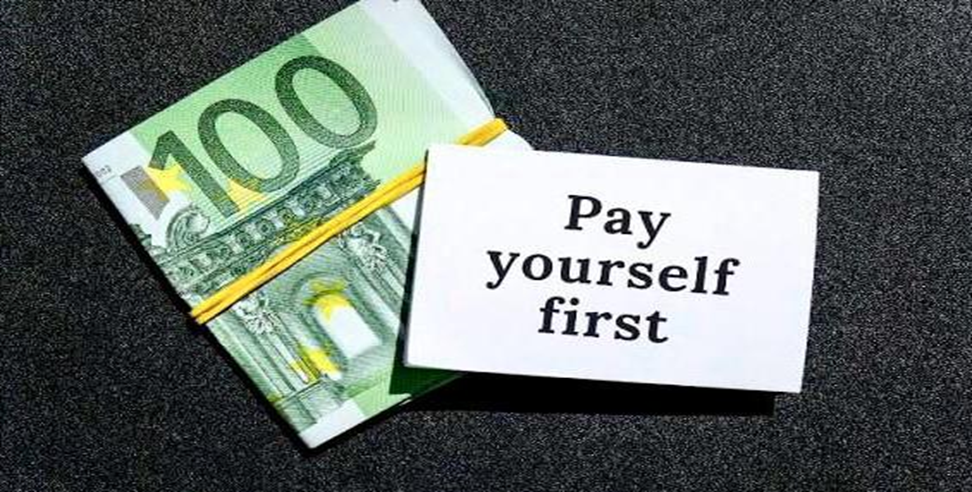
Finally, to ensure that your future self is protected from your present spending habits, you must adopt the philosophy of paying yourself first. This strategy reverses the traditional budgeting equation where people spend their income on bills and fun first, and then save whatever is left over which is usually nothing. Instead, paying yourself first treats your savings contribution as the very first and most important bill you have to pay as soon as your salary hits your account.
Ideally, this should be automated so that a portion of your income is instantly transferred to a separate savings or investment account before you even have the chance to see it or spend it. By removing this money from your checking account immediately, you artificially lower your available balance, forcing you to adapt your lifestyle to the remaining amount. This creates a scarcity mindset that naturally curbs spending while ensuring that your financial goals are being met in the background. It guarantees that you are building wealth and a safety net every single month, regardless of how disciplined you feel, effectively prioritizing your long-term financial freedom over short-term gratification.
So, in conclusion, before you spend, pause and ask yourself why. If the purchase is planned, valuable, and aligned with your goals, enjoy it guilt-free. But if it’s driven by stress, boredom, image, or the thrill of the moment, take a step back not to punish yourself, but to protect your future.
Why does your salary disappear so quickly? Explore the everyday spending habits, financial pressures, and small expenses that can turn ₦150,000 into a mid-month money crisis.
Why do we spend money trying to look successful? Explore the psychology behind lifestyle spending, social pressure, and the hidden cost of looking financially fine.
Having enough money to buy something doesn’t always mean you can afford it. Learn a smarter way to evaluate purchases, protect your finances, and spend with confidence.